By Robert M. Marovich
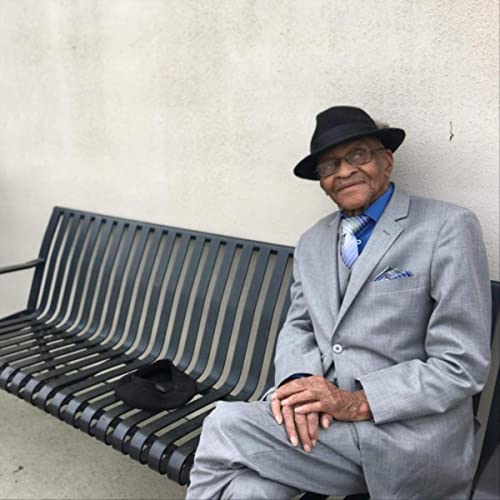
The Journal of Gospel Music was saddened to hear of the passing on February 26, 2026, of legendary singer Roscoe Robinson, in Birmingham, Alabama. He was 97.
I had the good fortune of interviewing Roscoe and staying in touch with him from time to time, especially whenever he released new music.
Amidst all the tributes being posted, I thought I’d share a section of my book, A City Called Heaven, that offers a history of Roscoe Robinson’s entry into gospel music.
The Emergence of Roscoe Robinson
Like Sam Cooke, Johnnie Taylor, Lou Rawls, and James Phelps, Roscoe Robinson left gospel, where he honed his craft in some of the era’s most popular quartets, to sing pop music. Unlike the others, however, Robinson returned to gospel music full-time.
Born May 22, 1928, in Dermott, Arkansas, Roscoe Robinson migrated to Chicago with his mother after his father’s death. He sang briefly with the Kelly Brothers, but when his mother moved to nearby Gary, Indiana, Robinson moved with her. He soon entered Gary’s quartet community, singing with Joiner’s Five Trumpets and the Royal Quartet, a group he called “about the biggest thing in Gary” at the time.
Probably named for its radio sponsor, the Royal Barber Shop, the Royal Quartet was indeed one of the most prestigious Gary-based gospel quartets of the early 1950s. At the time, the group consisted of Robinson, manager Joseph Dishman, Clifford Thomas, Alvin Dixon, Lindsey Davis, John Whitfield, and S. W. Smith. Its Sunday morning radio show on WJOB was so popular that they joined the Echoes of Eden, one of Northwest Indiana’s best-known female gospel quartets, on a November 1950 citywide salute to popular DJ Eddie Honesty.
Robinson first met Sam Cooke when the Royal Quartet and Highway QCs were participants in a Chicago Quartet Union monthly musical. Soon after, the QCs appeared with the Southern Sons in Little Rock, Arkansas. The Sons wanted Cooke to join them, but Cooke convinced them that “Scoe is the guy you need.” The Southern Sons met Robinson at a Gary restaurant and, going completely on Cooke’s recommendation, asked Robinson to audition for them.
Robinson sang with the Southern Sons briefly in 1951 and entered the army. After his discharge in 1953, he met the Silver Quintette’s Huey Lee Brown, who informed Robinson that Nashville, Tennessee’s Fairfield Four was breaking up. Some members, including Isaac “Dickie” Freeman, were forming a new group called the Skylarks. Brown persuaded Robinson to contact Fairfield Four manager Sam McCrary, and suggest that he and the Silver Quintette join McCrary as a reconstituted version of the Fairfield Four. McCrary consented, and with Robinson and Joe “Snap Your Fingers” Henderson, the Silver Quintette became the Fairfield Four at live appearances, although not for recordings. [NOTE: Roscoe said that he did not sing on the Silver Quintette’s Vee-Jay record]
A performance deal gone sour led Robinson to discontinue his association with the Fairfield Four. He linked up with Ernest James of the Sensational Nightingales, who brought him into his new quartet, the Gospel Jays. While performing with the Jays in California, Robinson ran into Archie Brownlee, lead singer of the Original Five Blind Boys of Mississippi.
For some time, Brownlee had been trying to get Robinson to join the Blind Boys, but Robinson forever declined. “I have to be honest with you,” Robinson said, “at the time, I was afraid of blind people.” He finally overcame his phobia of the sightless and capitulated to Brownlee’s persuasiveness. But Brownlee had bigger plans for the Gary resident than singing in the background. Robinson recalled:
[Brownlee said,] “They want to put me into the hospital.” I said, “Hey, man, who gonna sing [lead]?” He said, “You.” I said, “Man, I can’t even.” He said, “Yes you can.” I said, “No, I can’t.” Then, what really made me do it, he said, “Why you think I been sitting up late at night giving you pointers and singing with you?” That’s what he told me. I said, “Well, I guess you’re trying to help me.” He said, “I was trying to help you. You’re qualified. Take the group until I come back, man.”Brownlee entered Charity Hospital in New Orleans in early 1960. “We were in Baton Rouge, Louisiana,” Robinson said, “and Lloyd Woodard called to check on Archie. They told him he had passed.” Robinson assumed responsibility for the group’s leads thereafter.
Brownlee’s confidence in Robinson was well founded. He proved himself a soulful messenger of a gospel song, as demonstrated on “Weeping For A Mighty Long Time” and “The World Is Full Of Sin,” both recorded for Checker, and “Sending Up My Timber” on Peacock. But when Peacock owner Don Robey wanted the Blind Boys to sign a predated contract that suggested to Leonard and Phil Chess that the quartet had recorded for their Checker label while still under contract to Peacock, Robinson and Lawrence “Shorty” Abrams refused to sign. The issue ballooned into a legal matter. In Bil Carpenter’s Uncloudy Days, Robinson is quoted as saying that “it was hard for me to get a job with another gospel group because they made it look like I had left the Blind Boys for the white man. They didn’t get it how it should have been that I left because I was trying to do the right thing. People believed it, so promoters wanted no part of me.”
In her history of Chess Records, Spinning Blues Into Gold, Nadine Cohodas reported that the complaint between Chess and Peacock was so entangled that the FBI investigated the matter. In 1963, Judge J. Samuel Perry found in favor of Peacock, but the Chess brothers appealed. Subsequently, other Blind Boys spoke out about the altered agreement. Perry was criticized by the appeals court for “a failure to exercise sound legal discretion” in his earlier ruling and the matter was remanded to his court. Perry again found in favor of Peacock, and the case dragged on until 1970, when the appeals court threw out Perry’s judgment, nearly a decade after the initial complaint.
Meanwhile, Robinson and Abrams organized the Blind Boys of Ohio and cut one single for Constellation Records, “Sell Out To The Master.” Unable to get their music played on the radio, Robinson became disillusioned with gospel and shared his concern with producer Gene Barge. Barge wrote his friend a secular song, “That’s Enough,” and Robinson recorded it for his own Gerri label, named for his second wife. Ernie Leaner of United Distributors got the disc into the hands of Scepter Records. Scepter rereleased the song nationally and it became a top ten R&B hit.
“Ernie Leaner made me in the R&B field,” Robinson said. “He was the one who took my record and made sure it was played in Chicago, and it got big enough, and then he put out the feelers for me at different labels.” Robinson has since returned to gospel quartet singing, organizing a new aggregation, the Birmingham Blind Boys, in 2012.
Roscoe continued to record music in his 90s.
JGM extends its condolences to the family, friends, and many fans of Roscoe Robinson. He was a kind, generous, and warm person and we will miss him.
Written by : Bob Marovich

Bob Marovich is a gospel music historian, author, and radio host. Founder of Journal of Gospel Music blog (formally The Black Gospel Blog) and producer of the Gospel Memories Radio Show.